The Rent-Reduction Trap: When a Lower Asking Price Solves the Wrong Problem
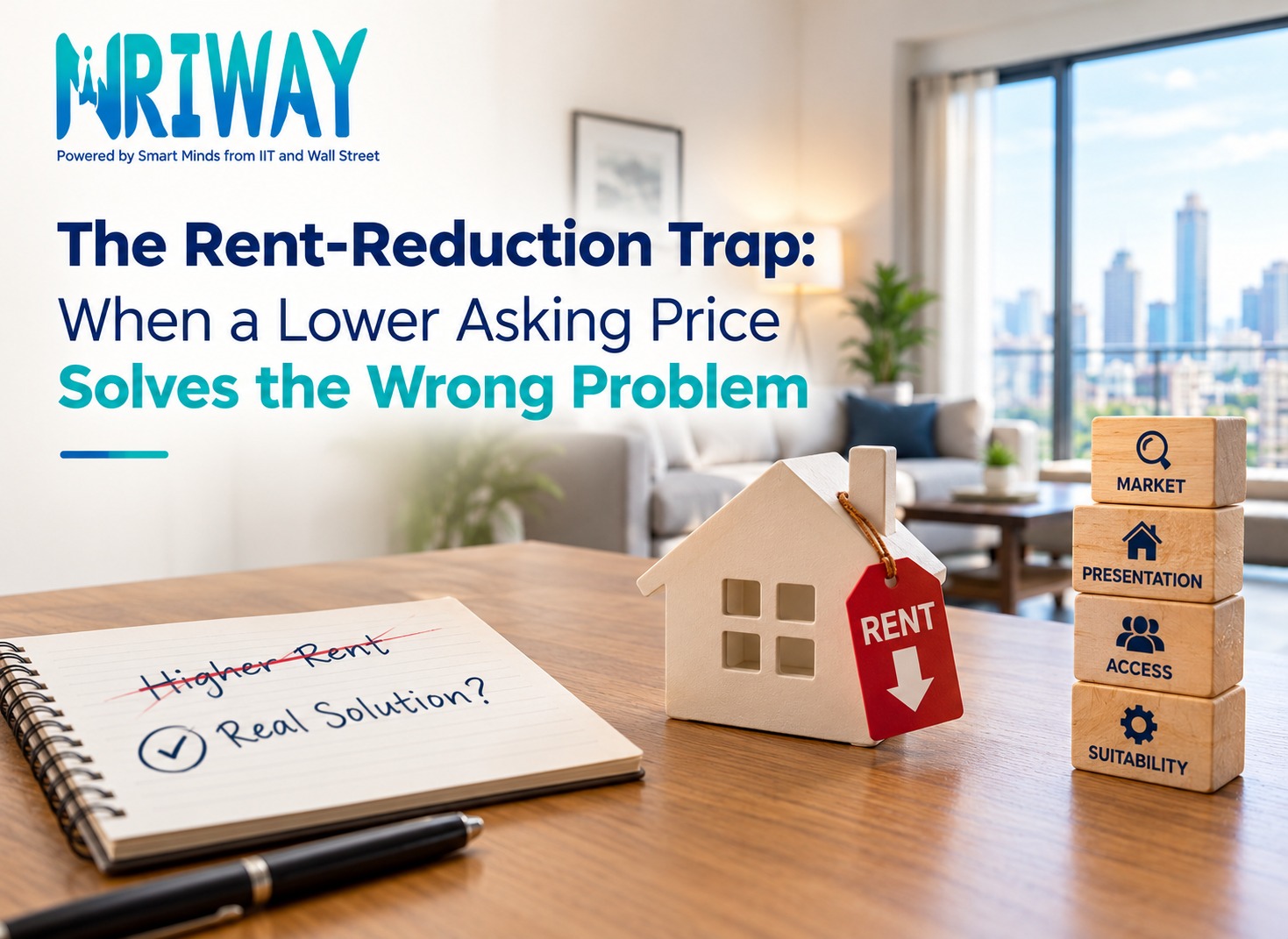
A decision framework for landlords | NRIWAY
When a flat remains vacant, reducing the asking rent can feel like the fastest solution. Sometimes it is commercially sensible. At other times, it sacrifices income without addressing the reason prospective Tenants are not proceeding.
The key is to distinguish a price problem from a presentation, access or suitability problem.
Four Signals to Investigate Before Changing the Rent
Signal 1: Very Few Relevant Enquiries
Review whether the asking rent is supported by comparable Properties and whether the listing accurately describes the flat. Limited reach or incomplete information may also explain weak enquiry volume.
Signal 2: Enquiries but Few Completed Visits
Check response times, viewing availability and whether the advertised move-in date aligns with the tenant's needs.
Signal 3: Visits but No Offers
Examine the feedback. Repeated concerns about the same feature may indicate a property issue or a mismatch between expectations and presentation.
Signal 4: Offers Consistently Below Asking Rent
Compare the offers with current, genuinely comparable evidence. Several independent offers can be informative, but the sample may still be too small or unrepresentative to establish market value conclusively.
Calculate the Trade-Off
Consider an illustrative property advertised at ₹40,000 per month.
- At ₹40,000, twelve fully occupied months produce ₹4,80,000 in gross rent.
- At ₹38,000, twelve fully occupied months produce ₹4,56,000 in gross rent.
- The annual difference, assuming the same occupancy period, is ₹24,000.
Now consider vacancy. If the property rents at ₹40,000 only after two months of vacancy within a twelve-month comparison window, it generates ₹4,00,000 in gross rent over the remaining ten months. At ₹38,000 with immediate occupancy for all twelve months, it generates ₹4,56,000.
Under these simplified assumptions, the lower rent produces ₹56,000 more gross income during the comparison period.
But this does not prove that reducing rent is always better. The property may secure a tenant at ₹40,000 sooner, or the lower-rent tenancy may involve different expenses or terms. Owners should compare realistic scenarios using the same time horizon.
A Disciplined Rent-Review Process
-
Gather comparable listings and record their dates and characteristics.
-
Separate advertised asking rents from verified transaction information.
-
Review visit feedback and the number of credible offers.
-
Calculate the financial effect of additional vacancy versus a lower rent.
-
Obtain the owner's approval before changing the asking price.
Do not promise a specific rent merely to win an instruction. A responsible assessment explains the evidence, uncertainty and available choices.
NRIWAY (OrangeLeaf Services Private Limited) assists property owners with tenant sourcing across Pune, Mumbai, Bengaluru and Kolkata.
Considering a rent revision? Discuss the property's position, owner priorities and leasing options with NRIWAY before making the decision.
All calculations are illustrative and exclude taxes, maintenance, brokerage, other costs and any differences in lease terms.
Related Posts



Thank You

Thank you for subscribing to our newsletter.